
“Raw Purslane is much used in salads, with oil, salt and vinegar. It cools the blood and causes appetite.” ~Gerard
It’s been a challenging year for gardeners. Heavy spring rain, a late frost and cool temperatures in August meant a much later start for many plants, setbacks and sodden soil.
If your squashes are loaded with powdery mildew, your tomatoes show no hint of ripening and the growth of your peppers hasn’t budged in weeks, take comfort, you are not alone. But instead of commiserating over what could have been, but wasn’t, I suggest you celebrate nature’s wild bounty instead. Rather than gloomily wandering up and down your rows lamenting the desultory Solanums, the flea beetle bitten Brassicas and the mildew-y melons, cast your eye between and under your struggling domesticated veg and keep a lookout for those resilient, hardy weeds that cheerfully thrive in less than ideal conditions. Chickweed, amaranth and lambsquarter’s will gladly accompany you from field to plate and you can forget about the spinach and lettuce that bolted weeks ago.
One of my favourite plants that grows in garden beds and sidewalk cracks alike is purslane (Portulaca oleracea). It is a low growing, sprawling thing with smooth, reddish, prostrate stems.
It’s been a challenging year for gardeners. Heavy spring rain, a late frost and cool temperatures in August meant a much later start for many plants, setbacks and sodden soil.
If your squashes are loaded with powdery mildew, your tomatoes show no hint of ripening and the growth of your peppers hasn’t budged in weeks, take comfort, you are not alone. But instead of commiserating over what could have been, but wasn’t, I suggest you celebrate nature’s wild bounty instead. Rather than gloomily wandering up and down your rows lamenting the desultory Solanums, the flea beetle bitten Brassicas and the mildew-y melons, cast your eye between and under your struggling domesticated veg and keep a lookout for those resilient, hardy weeds that cheerfully thrive in less than ideal conditions. Chickweed, amaranth and lambsquarter’s will gladly accompany you from field to plate and you can forget about the spinach and lettuce that bolted weeks ago.
One of my favourite plants that grows in garden beds and sidewalk cracks alike is purslane (Portulaca oleracea). It is a low growing, sprawling thing with smooth, reddish, prostrate stems.
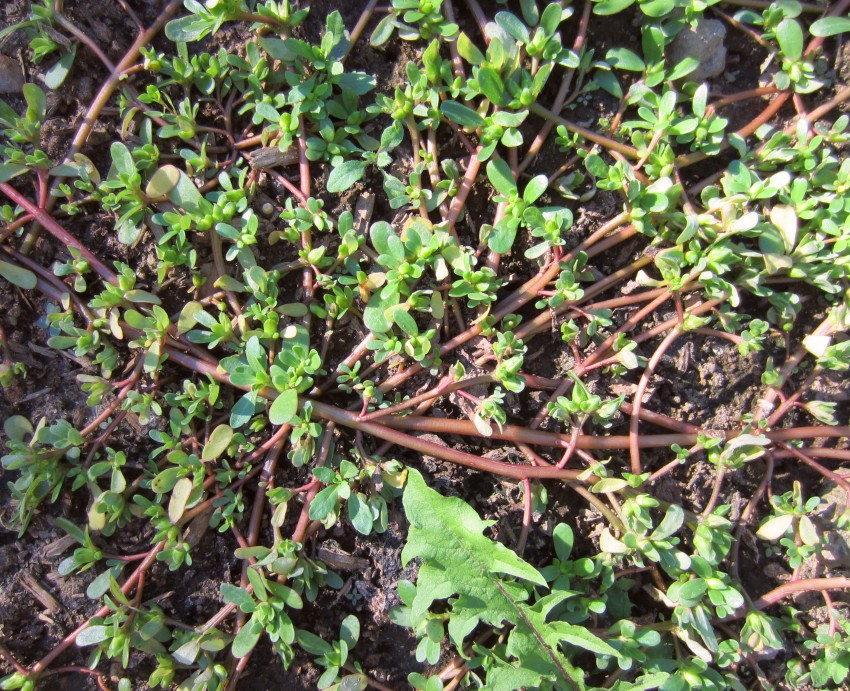
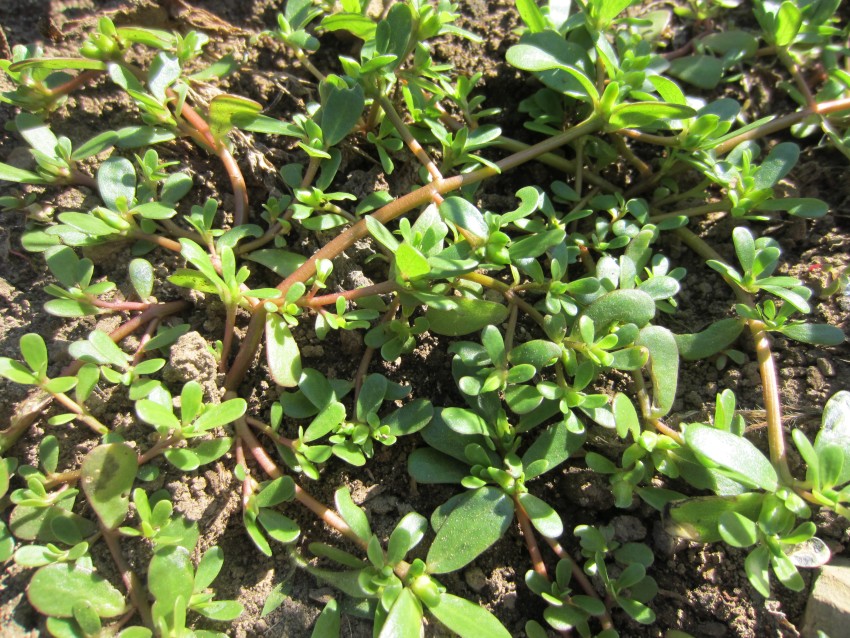
The leaves are alternate and spatulate, being rounded at the apex and narrow at the base. Both leaves and stems are succulent and fleshy.
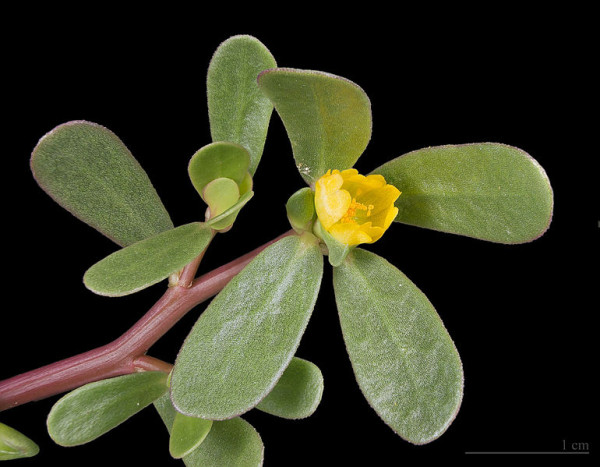
The five petalled, yellow flowers are small and only open for a few hours in the morning.
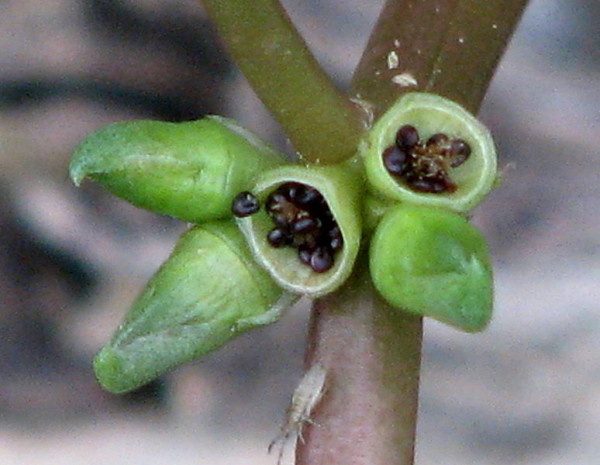
Tiny black seeds are borne in a wee cup.
The plant is native to North Africa but naturalized in North America where it is considered invasive in some areas. Varieties are cultivated in Europe, the Middle East, Asia and Mexico.
Purslane is tasty! Tart, crunchy and juicy it can be eaten raw, pickled and cooked. It goes nicely with scrambled eggs, potato salad and as an addition to any garden salad. In Greece a dish called andrakla is prepared by frying purslane with feta, tomatoes, onions, garlic, oregano and olive oil. The plant is mucilaginous and the resulting, slippery, slime-y, gooeyness might be off-putting to some, but that same mucilage makes for a great soup thickener. Aside from mucilage, the plant contains some pretty amazing constituents, making it a spectacular superfood that would rival the latest alternative health-food fad. Move over goji berries!
The tart flavour is due to high concentrations oxalic acid and malic acid. The malic acid is interestingly, at its highest amount at night and early morning. Throughout the day the malic acid is converted to glucose, so you can time your harvest for a more tart or sweet taste depending on your preferences.
According to Southwest herbalist John Slattery, Purslane is also high in “norepinephrine, potassium salt, calcium, magnesium, iron, dopamine, catecol, pyrocatechol, and DOPA, antioxidant vitamins a-tocopherol, ascorbic acid, b-carotene, vitamin C, and glutathione, betalain, betacyanins, and betaxanthins; the amino acids: isoleucine, leucine, lysine, methionine, cystine, phenylalanine, tyrosine, threonine, and valine; essential fatty acids (EFAs) EPA, DHA, ALA.” Phew! That’s a lot of ‘ols’, ‘ines’ and ‘ins’!
It is the content of essential fatty acids that really make this plant shine. EFA’s cannot be produced by the body, so we must get them from external sources such as fish and grass-fed meat, which isn’t very helpful if you are a vegetarian. EFA’s are important for regulating inflammation in the body, maintaining immune functions and supporting brain, nervous system and female reproductive health.
Purslane just so happens to be bursting with EFAs. 100 grams of fresh leaves can contain between 300 to 400 mg of alpha-linolenic acid, which is an Omega-3 fatty acid. This is very beneficial, because most people tend to have an over abundance of Omega-6 fatty acids in their diet. Too much Omega-6 and too little Omega-3, contributes to increased inflammation, arthritis and even certain cancers.
There is a constituent in this wonder-weed to be aware of and that is oxalic acid. Oxalic acid in large amounts for prolonged periods of time can lead to the formation of kidney stones and interfere with calcium absorption. Cooking purslane in water will leach out some of the oxalic acid. As long as long your kidneys are not compromised and you are generally healthy, oxalic acid is relatively harmless in a reasonably diverse diet.
The plant has a history of medicinal use as well, especially topically for sores, boils, insect bites and bee stings. In Taiwan it was traditionally used for digestive disorders and for supporting the liver. In A Modern Herbal, Grieves writes that it was used for strangury, coughs, shortness of breath, hot agues and “all pains in the head proceeding from the heat, want of sleep or the frenzy.” From Culpepper we learn that “the herb if placed under the tongue assuayeth thirst. Applied to the gout, it easeth pains thereof, and helps the hardness of sinews, if it come not of the cramp, or a cold cause.” Purslane even had uses in the supernatural realm as an anti-magic herb, where it was spread around the bed to protect the sleeper from evil spirits.
Gather the leaves and stems at any point in the growing season, though before going to seed is best. The tender tips are choice if the plant is abundant and you prefer to be choosy. You’ll want to give it a good washing, as it grows low to the ground and is often covered with grit. Don’t confuse it with the toxic look-alike hairy-stemmed spurge (Euphorbia vermiculata).
Purslane is tasty! Tart, crunchy and juicy it can be eaten raw, pickled and cooked. It goes nicely with scrambled eggs, potato salad and as an addition to any garden salad. In Greece a dish called andrakla is prepared by frying purslane with feta, tomatoes, onions, garlic, oregano and olive oil. The plant is mucilaginous and the resulting, slippery, slime-y, gooeyness might be off-putting to some, but that same mucilage makes for a great soup thickener. Aside from mucilage, the plant contains some pretty amazing constituents, making it a spectacular superfood that would rival the latest alternative health-food fad. Move over goji berries!
The tart flavour is due to high concentrations oxalic acid and malic acid. The malic acid is interestingly, at its highest amount at night and early morning. Throughout the day the malic acid is converted to glucose, so you can time your harvest for a more tart or sweet taste depending on your preferences.
According to Southwest herbalist John Slattery, Purslane is also high in “norepinephrine, potassium salt, calcium, magnesium, iron, dopamine, catecol, pyrocatechol, and DOPA, antioxidant vitamins a-tocopherol, ascorbic acid, b-carotene, vitamin C, and glutathione, betalain, betacyanins, and betaxanthins; the amino acids: isoleucine, leucine, lysine, methionine, cystine, phenylalanine, tyrosine, threonine, and valine; essential fatty acids (EFAs) EPA, DHA, ALA.” Phew! That’s a lot of ‘ols’, ‘ines’ and ‘ins’!
It is the content of essential fatty acids that really make this plant shine. EFA’s cannot be produced by the body, so we must get them from external sources such as fish and grass-fed meat, which isn’t very helpful if you are a vegetarian. EFA’s are important for regulating inflammation in the body, maintaining immune functions and supporting brain, nervous system and female reproductive health.
Purslane just so happens to be bursting with EFAs. 100 grams of fresh leaves can contain between 300 to 400 mg of alpha-linolenic acid, which is an Omega-3 fatty acid. This is very beneficial, because most people tend to have an over abundance of Omega-6 fatty acids in their diet. Too much Omega-6 and too little Omega-3, contributes to increased inflammation, arthritis and even certain cancers.
There is a constituent in this wonder-weed to be aware of and that is oxalic acid. Oxalic acid in large amounts for prolonged periods of time can lead to the formation of kidney stones and interfere with calcium absorption. Cooking purslane in water will leach out some of the oxalic acid. As long as long your kidneys are not compromised and you are generally healthy, oxalic acid is relatively harmless in a reasonably diverse diet.
The plant has a history of medicinal use as well, especially topically for sores, boils, insect bites and bee stings. In Taiwan it was traditionally used for digestive disorders and for supporting the liver. In A Modern Herbal, Grieves writes that it was used for strangury, coughs, shortness of breath, hot agues and “all pains in the head proceeding from the heat, want of sleep or the frenzy.” From Culpepper we learn that “the herb if placed under the tongue assuayeth thirst. Applied to the gout, it easeth pains thereof, and helps the hardness of sinews, if it come not of the cramp, or a cold cause.” Purslane even had uses in the supernatural realm as an anti-magic herb, where it was spread around the bed to protect the sleeper from evil spirits.
Gather the leaves and stems at any point in the growing season, though before going to seed is best. The tender tips are choice if the plant is abundant and you prefer to be choosy. You’ll want to give it a good washing, as it grows low to the ground and is often covered with grit. Don’t confuse it with the toxic look-alike hairy-stemmed spurge (Euphorbia vermiculata).
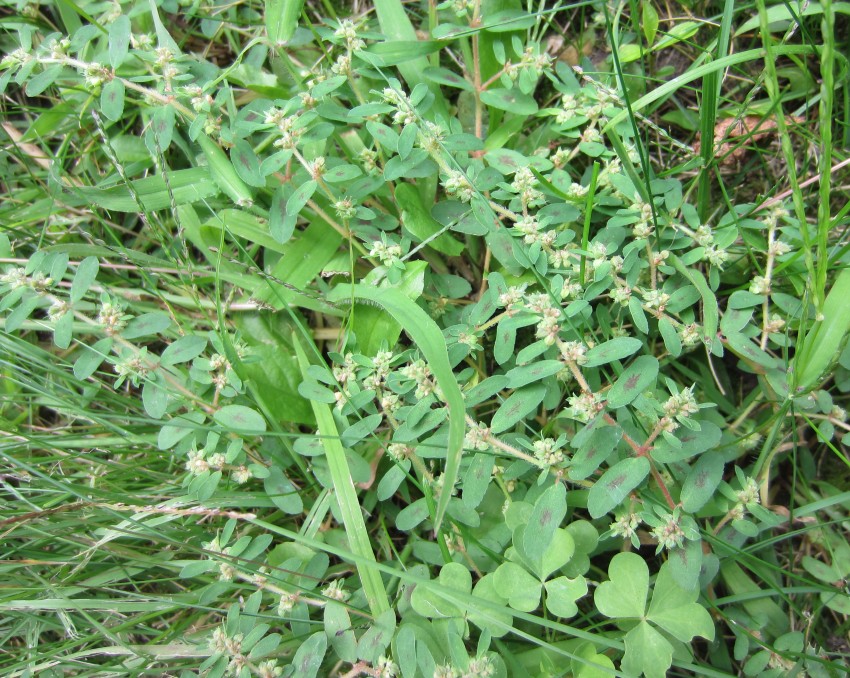
Edited for correction: Oops! I’m pretty sure the plant pictured above is actually spotted spurge (Euphorbia maculata). Same genus. Different species. Euphorbia vermiculata is, well, not spotted and looks like this.
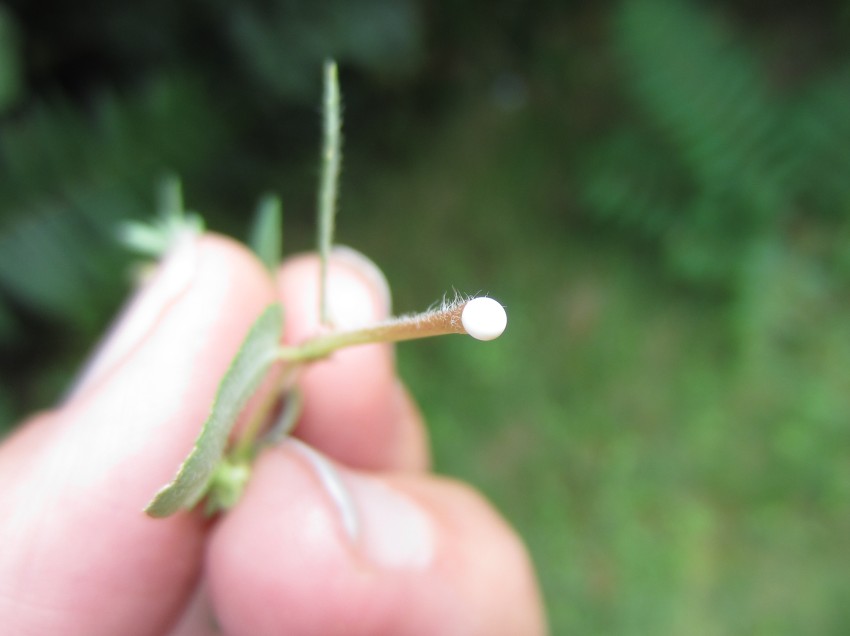
It’s very easy to tell apart though. For one thing, spurge has hairy stems, while the stems of purslane are smooth. Spurge is also much less succulent than purslane and the leaves are opposite rather than alternate. Finally, breaking the stem of spurge will reveal a white latex, which is not present in purslane.
It’s very easy to tell apart though. For one thing, spurge has hairy stems, while the stems of purslane are smooth. Spurge is also much less succulent than purslane and the leaves are opposite rather than alternate. Finally, breaking the stem of spurge will reveal a white latex, which is not present in purslane.
A recipe from The Weeder’s Digest:
Purslane à la française
1 chopped onion
1 tbsp olive oil
1 large bunch chopped purslane
250 ml veg or chicken stock
100g peas
100g snap or snow peas
100g broad beans
1 handful fresh, chopped mint leaves
Fry the onion in oil until soft. Add the purslane and stir until just wilted. Pour in the stock, add the other vegetables and simmer until everything is tender. Toss in mint just before serving.
References:
http://www.desertortoisebotanicals.com/verdolagas-purslane/
http://en.wikipedia.org/wiki/Portulaca_oleracea
Edible Wild Plants, John Kallas
A Modern Herbal, Mrs. M. Grieve
The Weeder’s Digest, Gail Harland
Culpeper’s Complete Herbal, Nicolas Culpeper
Image of purslane flower and seeds: Wikicommons
Purslane à la française
1 chopped onion
1 tbsp olive oil
1 large bunch chopped purslane
250 ml veg or chicken stock
100g peas
100g snap or snow peas
100g broad beans
1 handful fresh, chopped mint leaves
Fry the onion in oil until soft. Add the purslane and stir until just wilted. Pour in the stock, add the other vegetables and simmer until everything is tender. Toss in mint just before serving.
References:
http://www.desertortoisebotanicals.com/verdolagas-purslane/
http://en.wikipedia.org/wiki/Portulaca_oleracea
Edible Wild Plants, John Kallas
A Modern Herbal, Mrs. M. Grieve
The Weeder’s Digest, Gail Harland
Culpeper’s Complete Herbal, Nicolas Culpeper
Image of purslane flower and seeds: Wikicommons
 RSS Feed